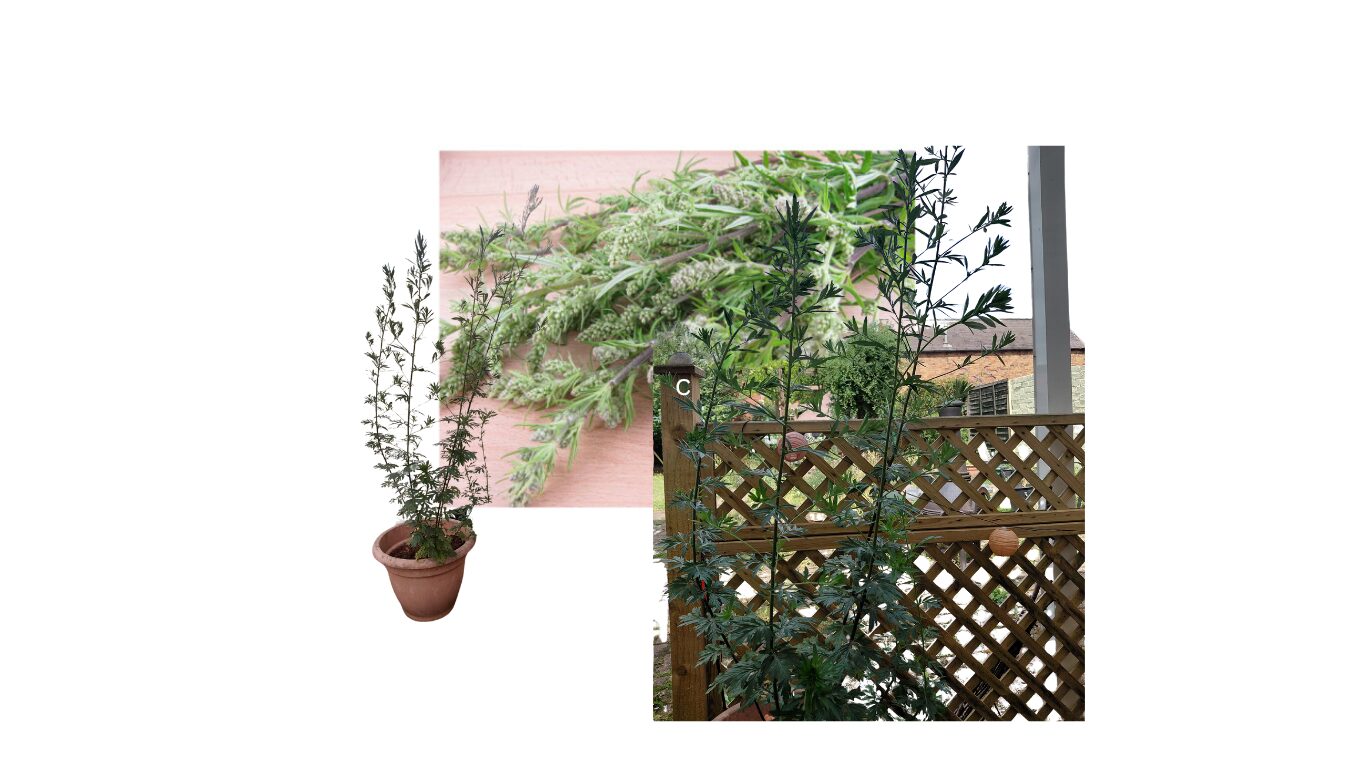

Mugwort (Artemisia vulgaris) is more than just a common plant growing wild in hedgerows,across Europe. For millennia, it has been revered as a herb of protection, vision, and liminal journeying. For hedgewitches and herbalists, mugwort can be one of the most potent tools in the witch’s cabinet, rooted in ancient tradition, myth, and mystery.
Mugwort is one of my favourite herbs. I have been growing my own, for a while now. I always like to harvest and pregate my herbs, but I always feel a bit guilty when I harvest mugwort, and dont worry I always ask first.
A History Rooted in Footsteps and Fire
Mugwort has a long and documented history of use across cultures, but it held particular significance among the Celts. The herb was often burnt as part of purification rituals, used to ward off evil spirits, and tucked into travellers’ shoes to protect against fatigue and harmful forces. The Roman naturalist Pliny the Elder even wrote that mugwort, when carried, prevented tiredness on long journeys, a belief that persisted well into the mediaeval period. I think I need to keep some in my camper van!
In Celtic tradition, mugwort is sometimes associated with Lughnasadh. In some traditions, it was one of the ritual herbs thrown into bonfires at midsummer, and bunches were carried home afterwards as a charm of protection for the home and threshold.
Some traditions included mugwort among the Nine Sacred Herbs (alongside plants like vervain and yarrow), though the exact list varied regionally.
Folklore and Superstition
Folklore surrounding mugwort is dense with magical associations. In British and Irish traditions, it was believed that the herb could repel witches, bad spirits, and the Evil Eye, which I always find amusing, considering how commonly witches use it.
Mugwort and Fairies in Folklore
Mugwort has long been associated with the spirit world and the otherworlds including fairies. In British and Irish folklore, it is said that mugwort placed near doors, windows, or even in shoes could protect against mischievous or harmful fairies, especially during liminal times such as midsummer, twilight, or seasonal festivals.
At the same time, mugwort’s properties were believed to enhance perception of the unseen, helping sensitive individuals detect fairies or other elemental beings.
Goddesses and Deities Associated with Mugwort
In modern pagan and witchcraft traditions, mugwort is commonly associated with deities of the moon, magic, healing, and liminality.
Artemis (Greek): The genus Artemisia is traditionally linked with Artemis, the Greek goddess of the moon, wild places, women, and childbirth, although the exact origin of the name is debated. Mugwort was traditionally used to support menstrual health and ease childbirth, aligning with Artemis’s domains.
While there is little historical evidence directly linking mugwort with the following deities, many modern practitioners include it in rituals connected to them because of its traditional magical properties.
Hecate (Greek): Goddess of witchcraft, crossroads, and necromancy. Mugwort, often burnt as incense or placed at the threshold, was believed to draw Hecate’s favour or protection.
Morrígan (Irish): Mugwort’s protective qualities and associations with prophecy and liminal spaces align it with the Morrígan, who governs fate, prophecy, and war.
Brigid (Celtic): As a goddess of healing and herbalism, Brigid is often honoured in practices involving sacred plants. Mugwort’s use as a healing and visionary herb makes it fitting in rituals connected to her.
Mugwort in Witchcraft and Hedgewitchcraft
For the witch, especially the hedgewitch, who walks between worlds, mugwort is one of the most reliable and spiritually charged herbs available. It is often used in the following ways:
🌿 Dreamwork
Perhaps mugwort’s most well-known magical property is its ability to enhance dreams. When placed under a pillow, burnt before bed, or drunk as a mild infusion, mugwort is said to stimulate vivid dreams, dream recall, and even lucid dreaming. It opens the gates to the subconscious, allowing the dreamer to receive messages and insight from the spirit realm.
Hedgewitches, those who traverse the “hedge” between the physical and spiritual realms, have traditionally used mugwort for visionary work.
🌿 Psychic Ability
Mugwort is often burnt during divination rituals to enhance intuition and second sight. Scrying, tarot, mirror work, and other forms of spirit communication can be deepened by the presence of mugwort, which sharpens the practitioner’s inner senses and calms distracting energies.
🌿 Protection
Despite its associations with spirit travel and liminal work, mugwort is also a potent protector. Worn in a sachet, hung above a door, or burnt as incense, mugwort guards against malevolent forces, nightmares, and ill will. In hedgecraft, it is sometimes used to protect the body while the spirit journeys, acting as a tether between the worlds.
🌿 From the Nine Herbs Charm (c. 10th century, Lacnunga Manuscript)
One of the earliest surviving references to mugwort in English magical tradition appears in the Nine Herbs Charm (Nigon Wyrta Galdor), preserved in the Lacnunga, an Old English medical and magical text compiled around the 10th century.
Old English (Anglo-Saxon):
“Urce mugwyrt,
þu mæg to wið untrumum
and wiþ ǣlces attres,
and wiþ þæs lyges onflyge,
þu mæg wiþ þam fǣonde
þe færð geond folc.”
Modern English Translation:
“Mugwort, you are mighty against illness,
and against poison of every kind,
and against the flying venom,
you are mighty against the foe
that fares through the land.”
This text comes from the Nine Herbs Charm (Nigon Wyrta Galdor), part of the Lacnunga, an Old English medical and magical text compiled circa the 10th century. Preserved in British Library Harley MS 585, it blends early English pagan herbal lore with later Christian influence.
Translation adapted from:
Stephen Pollington, Leechcraft: Early English Charms, Plant Lore & Healing (Anglo-Saxon Books, 2000)
Karen Louise Jolly, Popular Religion in Late Saxon England: Elf Charms in Context (University of North Carolina Press, 1996)
Mugwort Today: A Word of Caution
While mugwort continues to be a beloved ally in modern witchcraft, it must be approached with respect and care, it should not be used during pregnancy. Some people may also be allergic, especially those sensitive to plants in the Asteraceae family (such as ragweed or daisies). Always research contraindications before using mugwort medicinally.
Disclaimer: The information in this article is for educational purposes only and should not replace professional medical advice. Always consult your GP or another qualified healthcare professional before using mugwort or any herbal remedy medicinally.

Pagan Portals – Living Fairy: Fairy Witchcraft and Star Worship by Morgan Daimler
I highly recommend reading any of the Pagan Portal Books. There are so many topics. I will slowly list the ones I have read. The good thing about them is that they are informative but not too long.

For tools for your craft and personal path, visit The Psychic Tree. Use my code HEDGEWITCHJOURNALSBLOG